🌲 Holly
🎨 Color Palette
About Holly
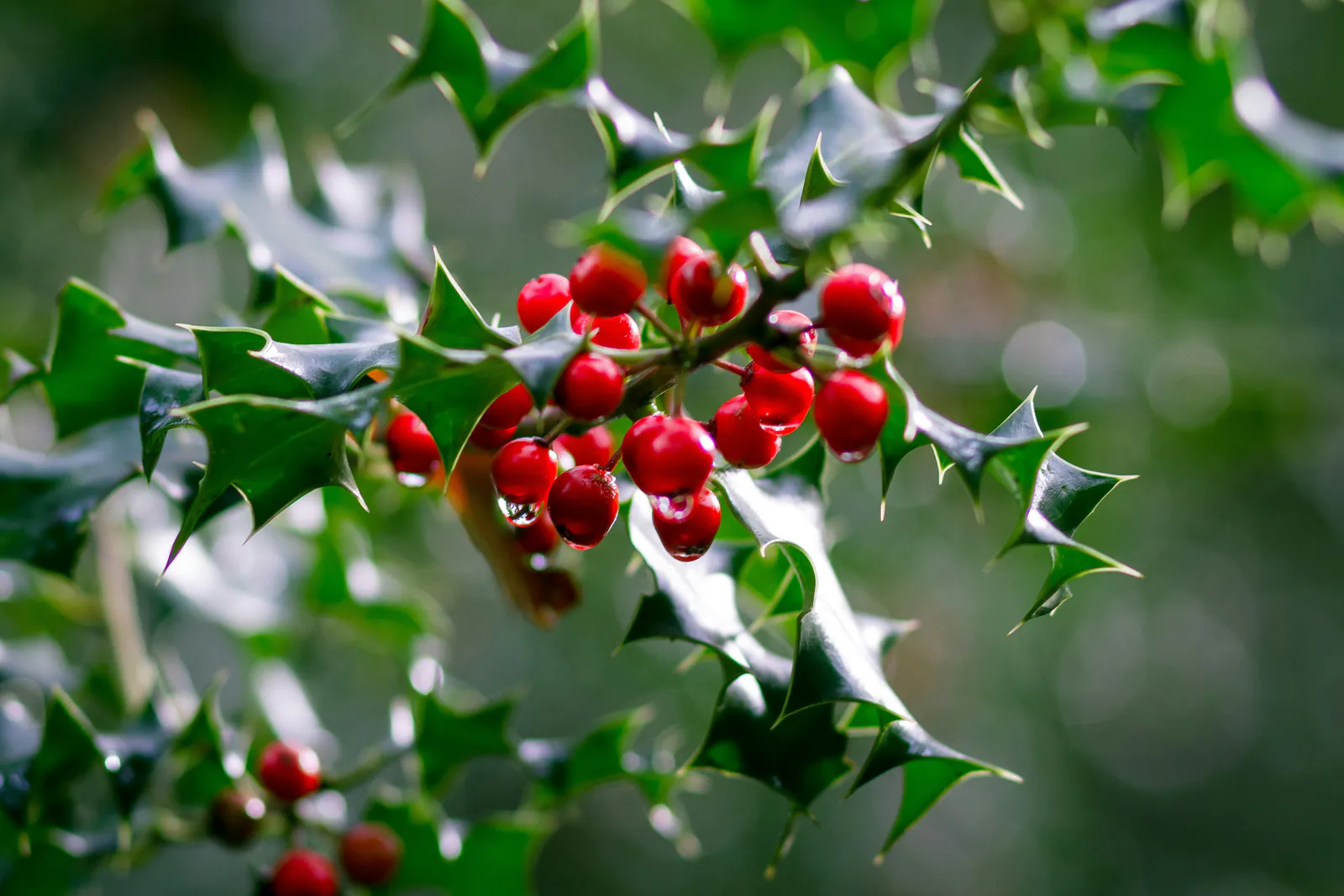
The term holly most often refers to species of the genus Ilex (Aquifoliaceae), in particular the European holly (Ilex aquifolium), a broad-leaved evergreen shrub or small tree prized for its dense habit, glossy, leathery leaves and glossy winter fruit. Leaves are generally dark green and may be edged with sharp thorns, particularly on lower or juvenile shoots, while upper branches and some cultivars may bear less thorny foliage. Holly is generally dioecious, with male and female flowers borne on separate plants; small white flowers with four petals are produced in spring and, when pollination takes place, female plants develop red (sometimes yellow or orange) berry-like drupes that persist into winter. The fruits are an important seasonal food source for birds, helping to disperse seeds, but are slightly toxic to humans and many domestic animals if eaten in quantity.
🌱 Detailed Care Guide
📐 Growth & Structure
📅 Phenology
🌍 Ecology
✨ Usage & Benefits
- ornamental
- medicinal
⚠️ Safety & Traits
🌱 Propagation
🧪 Soil & Nutrition
🐛 Pests & Diseases
📝 Expert Advice
Grow holly in fertile, humus-rich soil that remains evenly moist but drains well. A soil improved with organic matter (leaf compost) is ideal. It prefers slightly acidic to neutral conditions; it can tolerate some alkalinity but may show chlorosis on very calcareous soils. Avoid waterlogged, compact soils - improve heavy clay with organic matter and ensure drainage; mulch to conserve moisture and protect roots.
Holly (Ilex) is most often grown from semi-ripe cuttings, but seeds can be sown if you're prepared for slow, irregular germination. Collecting and preparing seeds: - Harvest ripe berries in late autumn/winter. - Remove all pulp (macerate and wash); pulp can inhibit germination. - Use fresh seeds whenever possible. Stratification (recommended): - Holly seeds are deeply dormant and generally require a warm period followed by a cold one. - Warm stratify in a moist medium (e.g. sand or peat substitute) at around 15-20°C for ~3-4 months, then cold stratify at around 1-5°C for ~3-4 months. - If you don't carry out a planned hot+cold treatment, expect to need at least 2-3 months of cold and potentially much longer before germination. Sowing: - Sow in late winter/spring after stratification. - Use acidic to neutral, well-drained soil for seeds; avoid lime. - Sow thinly and cover lightly (approx. 5-10 mm) with fine compost or sand/chips. - Keep evenly moist (not soggy) and place in light shade/mid-shade. Aftercare: - Germination can take several months and may extend into the second spring; keep pots weed-free and protected. - Transplant or pot when seedlings are large enough to handle; harden off and plant once well rooted, protecting young plants from extreme frost and drought.
Holly (Ilex spp.) generally feeds lightly to moderately. If growth is healthy and foliage is deep green, fertilizing may not be necessary; it's best to apply a 5-8 cm (2-3 in.) mulch of compost or leaf mold each spring to provide nutrients and conserve moisture. When growth is weak or leaves are pale, fertilize once a year in early spring (late winter to early spring, before new growth) with a balanced, slow-release fertilizer formulated for acid-loving shrubs (e.g. azalea/rhododendron/camellia feed), applying labeled rates to the root zone and watering well. Avoid heavy nitrogen applications and avoid fertilizing from midsummer onwards, as late fertilization can encourage tender growth that is more susceptible to winter damage. Use a soil test to guide applications and maintain a slightly acid soil (many hollies prefer a pH of around 5.0-6.5); chlorosis on alkaline soils is best treated by correcting pH/iron availability rather than by repeatedly increasing fertilizers.
Apply organic mulch (e.g. composted bark, leaf compost, well-decomposed garden compost) to a depth of 5-8 cm over the root zone to conserve moisture and suppress weeds. Keep the mulch 5-10 cm from the stem/trunk to avoid rot and vole damage, and spread it to the drip line (or beyond) where possible. Acid mulches such as pine bark or needle litter are suitable for holly.
Holly (Ilex spp., particularly Ilex aquifolium) has a limited history of traditional use: the leaves were used as a mild diuretic and for feverish colds/catarrhs, and sometimes as a laxative; the berries were once used as an emetic/purgative. However, holly berries are considered toxic and can cause severe gastrointestinal upset, so medicinal use is not recommended without professional advice.
Prune lightly each year to maintain shape and density, first removing dead, damaged, diseased or crossing shoots. The safest time is late winter and early spring, before new growth begins; otherwise, prune just after flowering if you don't mind reducing fruiting. If you want the berries to be on display in autumn/winter, avoid pruning after flowering and limit pruning to late winter. Prefer selective thinning cuts down to one lateral branch rather than repeated shearing, which can create a dense outer shell and a sparse interior. Avoid heavy pruning in late summer or autumn, as tender regrowth may not harden off before the cold, increasing stress. Overgrown plants can be rejuvenated by cutting back by a third a year for 2-3 years; wear gloves, as the leaves can be prickly.
📋 Additional Information
🤝 Companion Plants
These plants grow well together:
📖 View Complete Guide
For the full interactive experience with additional photos, personalized advice, and gardening tools:
Visit Aphylia →